
If your circuit breaker trips every time you run the microwave and toaster simultaneously, or you’re planning a major renovation that’ll add new appliances, your electrical panel might be due for an upgrade. Replacing an outdated 60-amp or 100-amp panel with a modern 200-amp system isn’t just about convenience, it’s a safety issue and often a permit requirement for any significant electrical work. The cost varies widely depending on panel size, labor rates in your area, and whether you need additional work like new wiring or a meter relocation. Here’s what homeowners can expect to pay in 2026.
Table of Contents
ToggleKey Takeaways
- The average cost to upgrade an electrical panel ranges from $1,300 to $4,000, with most homeowners paying around $2,200 as of 2026, including materials, labor, permits, and inspections.
- A 200-amp panel upgrade typically costs $1,800 to $3,500 and is the current standard for most residential homes with modern appliance loads.
- Frequent breaker trips, flickering lights, burning smells, or outdated fuse boxes are red flags indicating your home needs an electrical panel upgrade.
- Additional costs beyond the panel itself—such as new wiring, meter relocation, grounding upgrades, and asbestos removal—can significantly increase your total electrical panel upgrade expense.
- Always hire a licensed electrician for panel upgrades, as this is not a DIY project due to serious electrocution and fire hazards; get at least three written quotes before committing.
- Preparing the work area and bundling additional electrical projects during the upgrade can help you save money on labor and service call costs.
Average Cost to Upgrade an Electrical Panel
Most homeowners spend $1,300 to $4,000 to upgrade an electrical panel, with the national average landing around $2,200 as of early 2026. That figure typically includes the panel itself, labor, permits, and inspection fees.
A basic 100-amp panel upgrade in a straightforward installation runs $1,200 to $2,000. Stepping up to a 200-amp panel, the current standard for most homes, pushes the range to $1,800 to $3,500. If you’re upgrading from an old fuse box or a panel that hasn’t been touched since the 1970s, expect the higher end of that range due to code compliance updates.
For homes with heavy electrical loads, think whole-home generators, EV chargers, or workshops with 240V equipment, a 400-amp service upgrade can hit $3,500 to $6,000 or more. That price jumps significantly if the utility company needs to upgrade the transformer or run new service lines to your property, which can add another $1,000 to $3,000.
Keep in mind these are ballpark figures. Regional differences, existing wiring conditions, and whether your main disconnect is inside or outside the home all shift the final number. Always get at least three written quotes from licensed electricians before committing.
Factors That Affect Electrical Panel Upgrade Costs
Several variables can push your project cost above or below the average. Understanding these helps you budget accurately and avoid sticker shock when quotes come in.
Panel Size and Amperage
The amperage rating determines how much electrical load your home can handle. 60-amp and 100-amp panels are common in older homes but struggle with modern appliance loads. Upgrading to 200 amps costs $1,800 to $3,500 on average and covers most residential needs, including central AC, electric ranges, and a handful of high-draw devices.
If you’re adding an EV charger (which typically draws 40-50 amps), a hot tub, or planning a large addition, you might need a 400-amp service. The panel itself costs $400 to $800, but labor and utility coordination can double or triple the total expense. Some jurisdictions require a service upgrade if your remodel increases the home’s electrical load by a certain percentage, check with your local building department early in the planning phase.
Material costs for the panel alone range from $150 for a basic 100-amp box to $600+ for a 400-amp unit with surge protection. Brands like Square D, Siemens, and Eaton dominate the residential market: they’re code-compliant and parts are readily available.
Labor Costs and Location
Electricians typically charge $75 to $150 per hour, depending on region and experience. A straightforward panel swap might take 6 to 10 hours, but if the electrician needs to relocate the panel, upgrade the grounding system, or replace the main service mast, labor hours, and costs, climb quickly.
Urban areas and high-cost-of-living markets skew higher. Expect to pay premium rates in cities like San Francisco, New York, or Seattle. Rural areas might see lower hourly rates, but travel fees can offset the savings if you’re far from the electrician’s base.
Permit fees add another $50 to $300, depending on jurisdiction. Some municipalities include the inspection fee in that cost: others charge separately. Don’t skip the permit, insurance companies and future buyers will ask for proof of permitted work, and unpermitted electrical upgrades can tank a home sale.
Additional Expenses to Consider
The panel itself is just the start. Here are common add-ons that can inflate the final bill:
- New wiring: If your existing wiring is aluminum, cloth-insulated, or doesn’t meet current National Electrical Code (NEC) standards, the electrician may need to run new circuits. Budget $6 to $10 per linear foot for new wire runs, plus the cost of opening and patching walls.
- Meter relocation or upgrade: Older homes sometimes have the meter on the interior wall. Modern code often requires an exterior meter base. Moving it costs $400 to $1,500, depending on complexity and whether the utility company needs to disconnect and reconnect service.
- Grounding system upgrades: Homes built before the 1960s might lack proper grounding. Adding or upgrading ground rods and bonding the system to the water main adds $150 to $500.
- AFCI and GFCI breakers: Arc-fault circuit interrupters (AFCIs) and ground-fault circuit interrupters (GFCIs) are now required in most rooms per NEC standards. These specialized breakers cost $35 to $80 each, compared to $5 to $15 for standard breakers.
- Surge protection: Whole-home surge protectors integrate into the panel and run $200 to $500 installed. They’re worth it if you live in an area with frequent lightning strikes or unstable grid power.
- Asbestos or lead paint abatement: If the old panel is mounted on a wall with lead paint or surrounded by asbestos-containing materials, you’ll need certified remediation before the electrician can start. That’s a separate line item, often $500 to $2,000 depending on scope.
Many home improvement cost guides break down regional pricing and help you anticipate these extras before you commit to a project.
Signs You Need an Electrical Panel Upgrade
Knowing when to upgrade isn’t always obvious, especially if the panel still “works.” Here are the red flags:
- Frequent breaker trips: If you’re constantly resetting breakers, your panel is undersized for your electrical load.
- Flickering or dimming lights: This can indicate voltage drops caused by an overloaded or failing panel.
- Burning smell or scorch marks: These are serious fire hazards. Shut off the main breaker and call a licensed electrician immediately.
- Fuse box instead of breakers: Fuse boxes were phased out decades ago and can’t handle modern electrical demands. Upgrading is both a safety and insurance issue.
- You’re adding major appliances or renovating: Installing an EV charger, adding a second HVAC unit, or finishing a basement often requires a panel upgrade to meet code.
- Your panel is a known hazard: Federal Pacific Electric (FPE) and Zinsco panels have documented failure rates and are considered fire risks. Many insurers won’t cover homes with these panels.
Recent data on electrical panel replacement costs shows that upgrading proactively, before a failure or code violation, often saves money compared to emergency service calls.
DIY vs. Hiring a Licensed Electrician
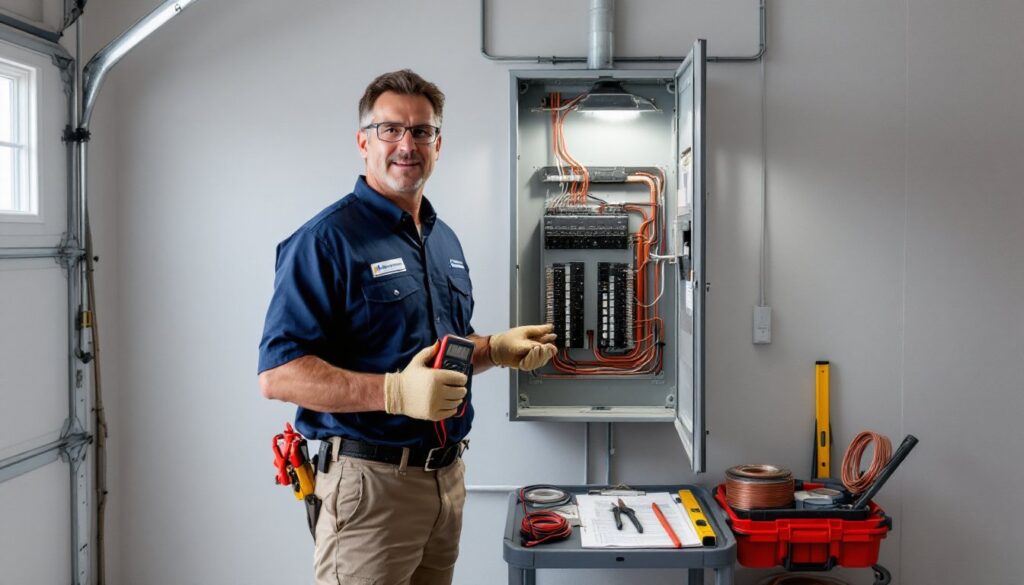
This is not a DIY project. Electrical panel upgrades require a licensed electrician in nearly every jurisdiction, and for good reason. Working inside the panel means exposure to live 240-volt service that can cause fatal electrocution even with the main breaker off, the line side (from the meter to the main breaker) remains energized until the utility company disconnects service.
Attempting this work yourself also voids permits and insurance coverage. If a fire starts due to faulty panel work and the insurer discovers unpermitted DIY electrical, they can deny the claim entirely.
What you can do to save money:
- Prep the area: Clear the space around the panel so the electrician can work efficiently. Move boxes, shelving, and anything within a 3-foot clearance zone (required by NEC Article 110.26).
- Get multiple quotes: Prices vary significantly. Three quotes give you leverage and help you spot outliers.
- Coordinate permits yourself: Some jurisdictions allow homeowners to pull permits, saving a small markup if the electrician usually handles that step.
- Bundle projects: If you’re already upgrading the panel, add other electrical work, new outlets, dedicated circuits, etc., to spread the service call cost.
For accurate budgeting, consult detailed electrical panel upgrade pricing that reflects current material and labor trends. A licensed pro will ensure the work is safe, code-compliant, and warrantied, worth every dollar when you’re dealing with the backbone of your home’s electrical system.